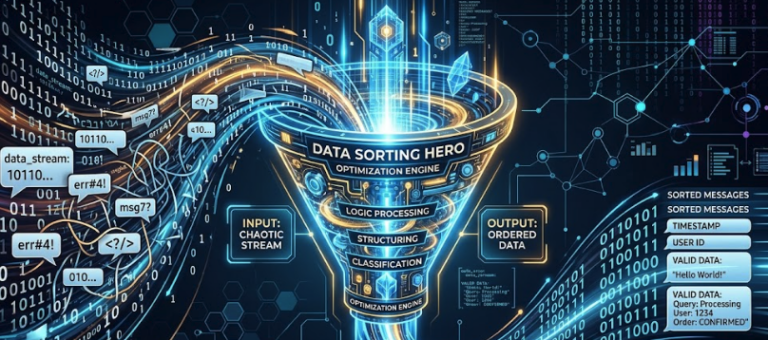
Every day, billions of messages fly across massive real-time communication platforms like Discord. Displaying these messages in perfect chronological order requires a rock-solid system for generating unique message identifiers.
But how do you create billions of unique, time-sortable IDs daily without relying on a central database bottleneck? Let’s break down the architecture of a high-throughput, distributed ID generation system.
The Problem with Auto-Increment and UUIDs
When building a standard web app, most developers reach for database auto-incrementing fields or generic UUIDs. At a massive scale, both of these solutions fail entirely.
- Database Bottlenecks: Auto-increment requires a single central database to coordinate numbers, which creates a massive performance bottleneck and a single point of failure at billions of messages.
- Lack of Time Locality: Traditional random UUIDs (like UUIDv4) are completely unsorted. If messages are stored with random IDs, the database will struggle to index them due to extreme B-tree fragmentation, making it extremely slow and expensive to fetch chat history in chronological order.
- Storage Overhead: Standard UUIDs consume 128 bits of space, doubling storage overhead and reducing network payload efficiency compared to a compact 64-bit integer.
The Solution: A 64-bit Snowflake Structure
To structure a unique ID so it naturally contains time information and server identity without central coordination, the ID is split into three logical parts to form a custom 64-bit Snowflake bigint:
- Timestamp Component: Positioned at the very beginning of the ID structure, this records the exact milliseconds the message was created, making the ID naturally time-sortable. A larger ID value always means a newer message.
- Machine ID Component: Gives each server a unique number so two servers never generate the same ID.
- Local Sequence Counter: Increments if multiple messages are created on the exact same server within the exact same millisecond.
When a client fetches chat data, the database can stream the messages sorted by the ID value directly. The frontend app simply renders the messages from the lowest ID to the highest ID to guarantee a perfectly ordered chat timeline.
Decoupled Architecture Components
3The system relies on decoupled components handling very specific responsibilities:
| Component | Primary Responsibility |
| API Ingress / Gateway | Receives inbound chat messages from worldwide users and forwards them asynchronously. |
| ID Generator Fleet | A cluster of independent, stateless Snowflake worker servers dedicated to assembling the custom IDs using local system time and their assigned machine number. |
| Worker Registry (ZooKeeper) | A coordination service used only when a server starts up to assign a unique, non-overlapping Machine ID to that specific worker node. |
| Distributed Storage Layer | A NoSQL database (like ScyllaDB or Cassandra) that uses the Channel ID as the partition key and the unique Message ID as the clustering key to keep messages automatically sorted on disk. |
Critical Edge Cases: Clock Drift & Sequence Overflows
Distributed systems are chaotic. Hardware clocks shift, and traffic spikes are inevitable. The ID generator must defensively handle these edge cases.
Handling Clock Drift If a server’s hardware clock shifts backward slightly, it might generate an ID with a timestamp that it already used, causing a critical data collision. To prevent this, the server keeps the last used timestamp in its memory.
- If the current system time is suddenly less than the last recorded time, the server detects clock drift.
- For a tiny shift (e.g., less than 5 milliseconds), the server thread simply pauses and waits for the physical clock to catch up.
- For a severe drift, the server intentionally stops generating IDs, throws an error, and lets the gateway route traffic to other healthy servers.
Handling Sequence Overflows The local sequence counter has a maximum limit per millisecond. If a massive traffic burst hits a single server and exceeds this limit before the clock ticks forward, the sequence counter overflows. Instead of generating duplicate IDs, the worker node locks further generation and forces the request thread to wait for a fraction of a millisecond until the system clock advances to the next tick. The counter then resets back to zero, ensuring zero collision risk.
Infinite Global Scaling and Resiliency
What happens if users are chatting across different geographic regions, like the US and Asia?
Because of the embedded Machine ID component, collisions are naturally impossible. Even if a server in the US and a server in Asia receive messages at the exact same millisecond and both are at sequence number zero, their generated IDs will still be completely different because their Machine IDs are globally unique. This allows the system to scale infinitely across multiple global regions with zero cross-region network cross-talk.
Furthermore, because the generation servers are stateless, system recovery is seamless. If an ID Generator server crashes completely, the API Gateway immediately routes traffic away from the dead node. When it recovers or a replacement spins up, it simply talks to the Worker Registry (ZooKeeper) to claim a fresh, unused Machine ID (or reclaim its old one), guaranteeing it can start making unique IDs again instantly without any data overlaps.